


-

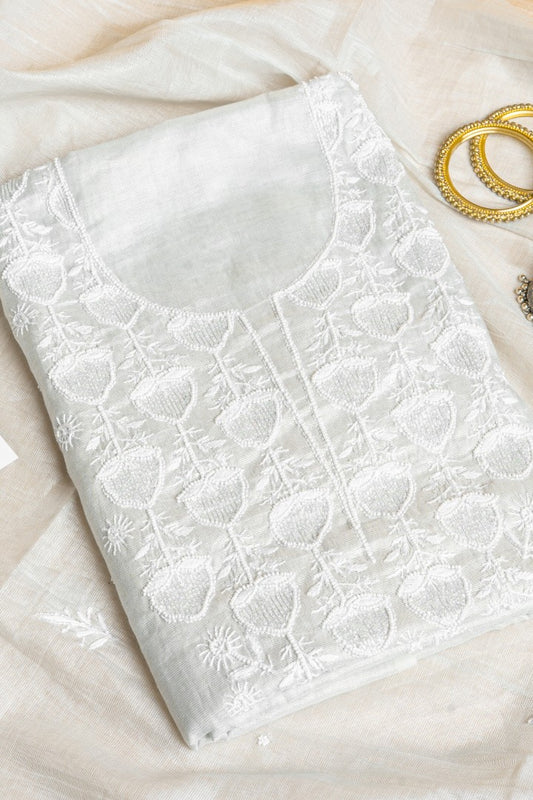 Sold out
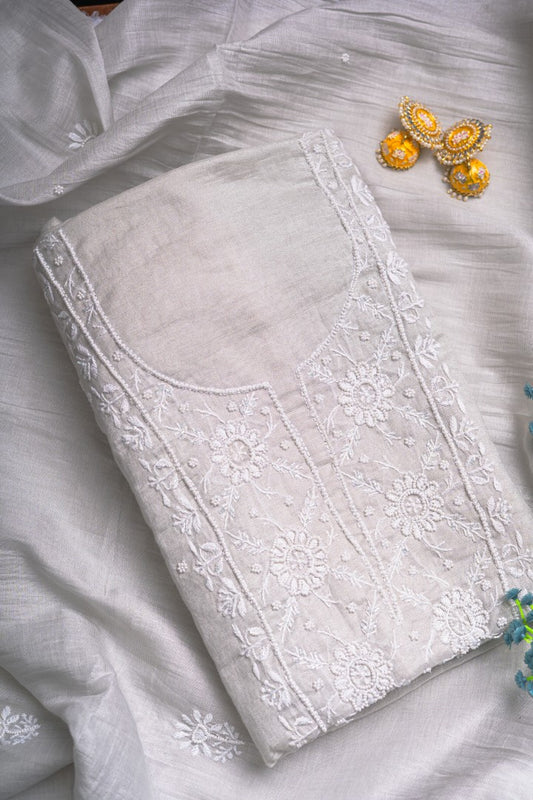
Lucknow · ChikanFrost Lily & Pearl
Regular price Rs. 7,999.00Regular price -

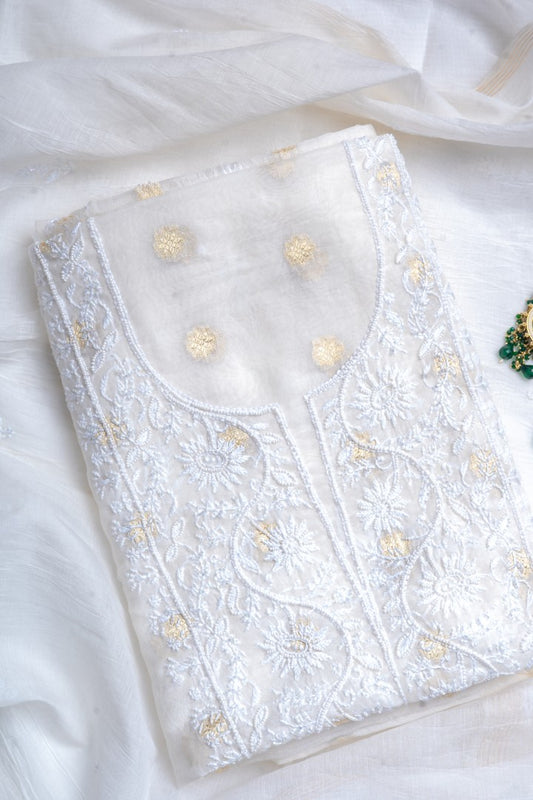 Sold out
Lucknow · ChikanGilded White Peony
Regular price Rs. 7,999.00Regular price -
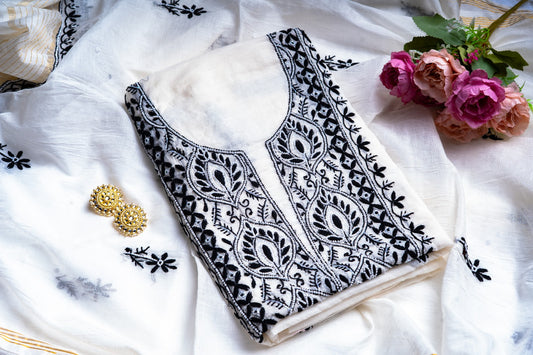
Lucknow · ChikanMonochrome Dahlia & Pearl
Regular price Rs. 6,999.00Regular price -
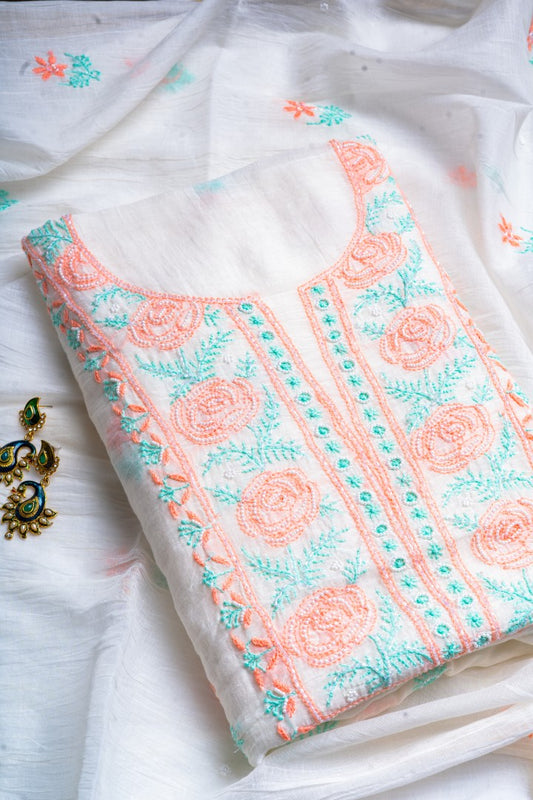
Lucknow · ChikanCoral Rose & Mint Pearl
Regular price Rs. 7,999.00Regular price -
Lucknow · ChikanFrost Dahlia & Pearl
Regular price Rs. 6,999.00Regular price -
Lucknow · ChikanMint Peony & Pearl
Regular price Rs. 7,499.00Regular price






Lucknow, Uttar Pradesh
Three hundred years of Chikan
Chikankari arrived in Lucknow under the Mughals and stayed, absorbed into the city until the two became inseparable. It is shadow work: the pattern is stitched on the reverse of the cloth, so what you see from the front is not thread but the ghost of it — a motif surfacing through fine cotton like breath on glass.
The cloth is held taut — in a small frame or simply in the hand — so every stitch lands with the same tension. An embroiderer works it for hours, and a single kurta can pass through four or five pairs of hands: one to block the pattern, one for the shadow work, one for the knots, one to open the jali, one to wash the printed guidelines away.
Nothing about it is fast. That is not a flaw in the process. It is the process.
— The Lucknow Edit
The Stitches
Thirty-two ways to tell a story
Six of them carry most of the work. Open any card to see how it is made, and how long it takes.
And twenty-six more
- Ghas Patti
- Pechni
- Bijli
- Kaj
- Kaudi
- Hathkadi
- Banarsi
- Kapkapi
- Karan
- Keel Kangan
- Bulbul Chashm
- Sidhaul
- Ghaspatti
- Makra
- Mandarzi
- Bhath
- Janjeera
- Dhania Patti
- Rozan
- Meharki
- Chanapatti
- Balda
- Jora
- Pashni
- Panna Hazara
- Katao

Meet the Maker
Salma Begum
Lucknow, Uttar Pradesh
She learned bakhiya at eleven, sitting beside her grandmother, and has worked it every day since. Thirty-four years at the frame. She can tell which of her apprentices worked a piece by the tension of the knots alone.
Also from the house
The other Edits

The Aligarh Edit
Appliqué · Patti ka kaam
Motifs cut from cloth, turned and hemmed by hand. Crisp silhouettes, soft layers, cloth on cloth.
- Patti work
- Cut by hand
- Hand-hemmed
 Coming Soon
The Jaipur Edit
Hand-block printing
Carved teak blocks and natural dye — indigo, madder, turmeric, iron black — printed in Sanganer and Bagru.
- Hand-block
- Natural dye